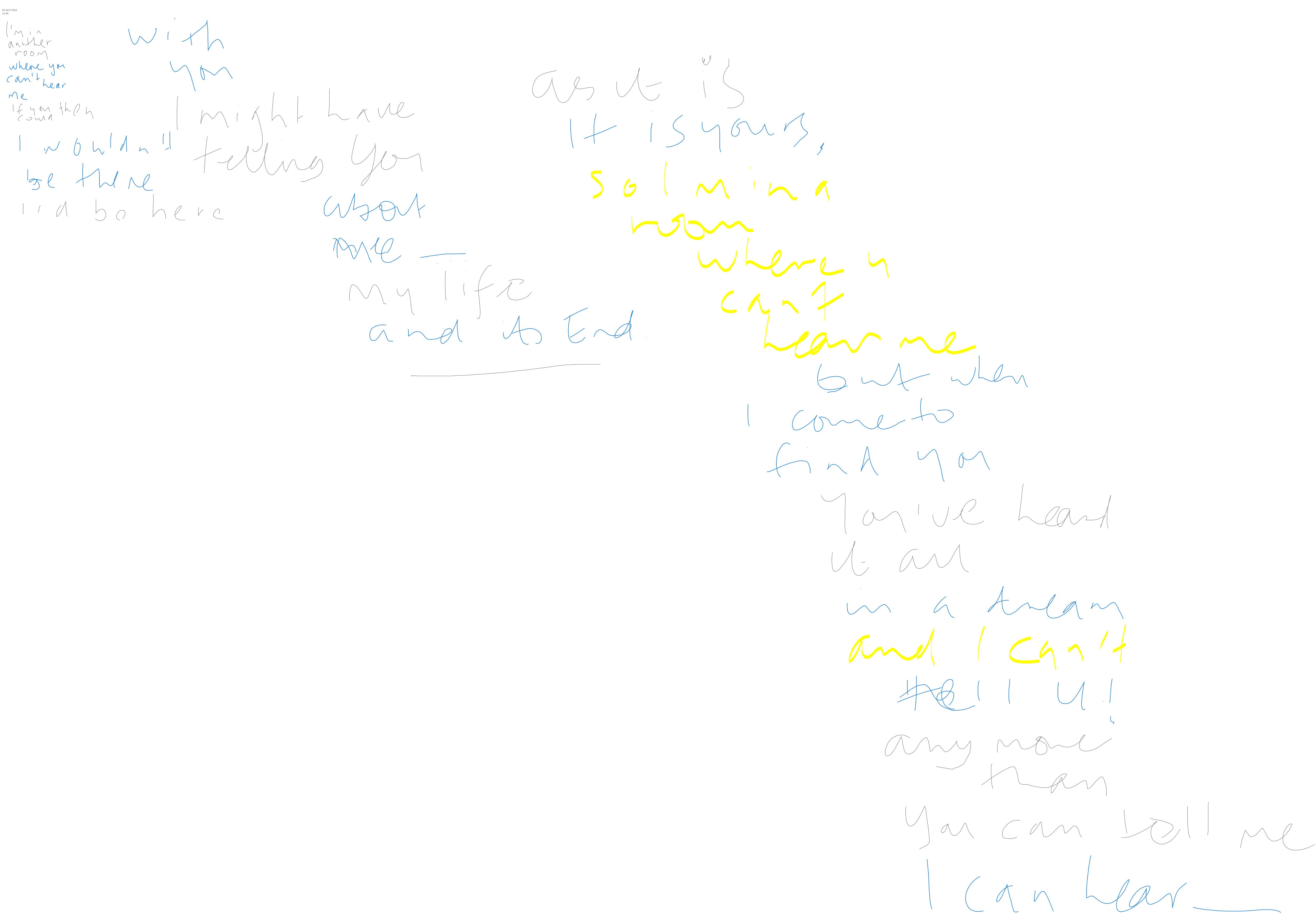
I’m in another room
where You can’t hear me
if you could then
I wouldn’t be here
I’d be there
with You
I might have been telling You
about me
My life
and its end
as it is
it is yours
so I’m in a room where You can’t hear me
but when I come to find You
you’ve heard it all
in a dream
and I can’t
tell You
any more
than
You can tell me
I can hear
I saw you this day,
man with a ponytail and beard,
whose face I should have recognised,
talking in a language
I’m learning.
I thought suddenly automatic your words,
apprentice automaton
that I am.
My eyes like a breeze and you blink,
slow down and glance beside me.
Briefly, the air settled,
my mind your speech un-captured.
You aim for the highest ideal. But that becomes defacto your judge. So you decide you don’t want to be judged. That you don’t head for the highest ideal. This has repercussions through entropy and foolishness that will lead to suffering.
Talking to Melissa can be a very rich experience. Depends on what you bring to it. Depends on how well you can listen. I was talking to Melissa whilst we were watching some dross on her television in her room at the care home. Of course the dross was passionately interesting because it was very rare. Dross can become quite addictively mundane. The first time you see it it’s like anything new, full of potential and possibility. I don’t remember what it was although I do remember gaining access to a variety of unusual television programmes whilst visiting Melissa recently.
On this occasion I think partly arising from frustration at elements in my own personal experience of life, I spoke to Melissa about our upbringing with Rosemary in particular. I said to Melissa, and she agreed, that we had been brought up to be producers of culture and not to be satisfied with being consumers.
Immediately this is said it negates itself. And that’s where my philosophy ends for today. Before it has begun with nothing other than a comfortable platitude that nevertheless contains truth.
So the spring has arrived finally. After one of the coldest early springs I can remember it’s finally warmed up. That’s coincided with what might well be some sort of biological need for spring cleaning. In particular I’m thinking at the moment about the drive I’ve got to clear my lovely back garden. I remember when we moved into the house in 2002. The back garden here is very very steep and when we moved in the land was practically toxic. The underlying land is made up of a lot of slag from steel mills and a variety of unpleasant things have been dumped in the garden over the years. Very steep but quite large for a Sheffield terrace house. There’s a flat area at the bottom which was really unusable when we first moved in and a set of very poorly constructed concrete steps that get you halfway down.
I recall very clearly saying to myself and perhaps to Saskia as well: “You know, this is the sort of garden that when people visit it in 10 years time they think it’s always already been like that. They don’t realise that it’s taken 10 years of patience and attention to get it there.”
Well it’s 15 years later and that’s not happened. Every year, to be honest not even every year, we put some labour into it but never enough to keep going through the season – to stop the convulvulus from overrunning everything that we plant. To the point that two apple trees have just been strangled out of existence. The things that have survived have done really well because the fact that they survived means they’re really strong and in the right place, suitable to the soil and the light et cetera. But it is always sad to look on the garden, it’s not even a symbolic representation of some sort of psychological failure. It’s just simply a material example.
When spring comes, along comes the spring cleaning urge. The material need to clear it up. And yes, of course, the psychological recognition that comes with increased light. The real turning point of the year is now.
And my thought on all this was simple. There’s nothing wrong with a psychological focus on the back garden. There’s nothing wrong with back gardens. There is no embarrassingly Freudian aspect to spending time in one’s back garden, taking care of one’s back garden. The back garden is a deep resource for the rest of the house. For the rest of the garden. For those people who inhabit it. The back garden is integral to the internal life of the family and it’s time to give it love and make it beautiful.
A friend of mine, Miroslav, just the other day posted a link to a short scene from a film titled “Gadjo Dilo”. It was a couple of minutes of footage of some Romanian Roma musicians playing and singing in a cafe, a young woman dancing whilst a young man recorded an audio tape of the music. The title means “Crazy Gadjo” or “Nutty Outsider” or some version of saying mad non-Roma person!
The clip was obviously sufficiently appealing to me that I followed a link through to a second clip. This one showed the young man who had been conducting the recording standing next to a fresh grave where an older Roma man wept and danced next to the grave of his friend whilst a young man sang and played the accordion. The older man drank from a bottle of vodka and poured libations on the grave through his tears. The song is called tutti-frutti.
This clearly appealed to me too, the word I’d use is pathos. Or perhaps I just say “duhkal”. Duhkal man o jilo. I say that quite a lot. So I managed to follow links through and find the complete film with English subtitles and I’ve posted the links below.
I’m not at all sure how to speak about this film. I’m not Roma so I don’t know how the representation of Roma feels. I am a Gadjo and I recognise the representation of the Gadjo dream. The Mad Gadjo. The Gadjo in this film is a French person. A young man. “Look at his big teeth!” says one of the Roma children in the film. I’ve got big teeth too and I was once a young man. This particular Gadjo Dilo in the film is looking for a singer, a gypsy singer, a Romanian gypsy singer called Nora Luca.
His father was a traveller the film tells us, his father wandered far and wide spending his time with remote people, recording them playing music and singing. We hear that he died somewhere in the Middle East with the Bedouin. His favourite tape, his favourite voice, his favourite recording was Nora Luca. This voice obviously haunted our young Gadjo Dilo and after his father’s death he set off into rural Romania in search of Nora.
He finds everything except a living Nora. He finds wonderful musicians, fiddle players, a precociously talented young accordionist and singer. He is taken into a Roma village by a man whose son has just been sent to prison. The drunk and mourning father adopts him on the local town square and takes him back home. There he lives, there he learns and there he eventually records music until one day he hears, finally, through tears, Nora Luca singing for him. But the voice comes from the young heroine of the film and she is not Nora Luca.
In a brutal ending to the film the young man buries his search for Nora Luca as his adoptive father had buried and mourned over the open grave of his friend. Tears, a dance and a vodka libation. He learns something of the way of the Roma by learning of their suffering. He can bury his love of Nora Luca as he needs must his father and live with real suffering in the present. And love. Suffering. And love.
So that’s the Gadjo Dilo story of the Roma. Suffering and Love. This Gadjo Dilo and that Gadjo Dilo.
“It’s some thing connected to meaning. An oblique waking up. Or a guilty secret. An automatic self disgust. There are whole sets of impulses that have pushed me. Chemically induced ones. Natural body exuberances and later self-inflicted. I just can’t capture anything about this in words. It’s about meaning. A really joyful sitting with, walking with, living with meaning. A search. I am a (re-) searcher. I keep returning. I’m walking through Abbeyfield Park being pulled by two small dogs and untangling their leads fairly unconsciously really. The path ahead of me is glistening with the reflected light from the street lamps on Burngreave Road. A double-decker is pulled up at the bus stop near the car rental and the lights are bright too. Trees, great beech trees, frame the whole scene which sits on the wall of the sky. I know I can catch something of it. I take a snapshot but the bus has moved on before I can finish, and when I look back so many things are missing.”
Loneliness
So I’m walking through that park and as I’m walking along the streets that evening I’m feeling lonely. I’ve an impulse that is towards discovering meaning but its manifestation is also a sadness, an anxiety, a tension. A need to share it. A need to communicate. A sense of isolation from some people close to me who don’t get it.
That’s the loneliness. And it’s a necessary loneliness I’m feeling at these moments. Because it can’t be completed without failure. That seems to be my default position: completion is failure. A sort of postcoital depression.
When I was younger that very thought (postcoital and depression) would have collapsed the thought process altogether. The notion that meaning, the search for meaning was eventually always collapsed back to sex and body function. But now that’s not the case. Rather that the body function is an index of a search for meaning.
Loneliness does capture that. I felt it for a long time and very intensely at moments in my life. The departure and separation between myself and Heidi, Coco’s mother. The other the death of my mother. There was such a longing and loneliness in both of those and one that I didn’t want to end. Feeling so ridiculously alive whilst feeling so pained and sad. Loving the feeling of life that comes with loss. Knowing that it can be overcome. That one can move beyond. And knowing that one loses access to something so magnificent and so terrifying.
The term loneliness has come to mind because of a mention in a Jack Kornfield talk of Hafez warning us not to let our loneliness go. Rather like the appearance of the postcoital, the presence of the Hafez poem on the web causes me disquiet. There are many references to it and all of them to a particular translation. But the idea is a solid one:
Don’t surrender your loneliness so quickly. Let it cut more deep.
Let it ferment and season you As few human or even divine ingredients can.
That’s exactly the feeling I’ve had in these moments of loneliness including the stupid (the Zizekian stupid do not forget) walk in the Park with the dogs and the missing bus. Loneliness is such an access point. But it’s a particular loneliness I’m writing about. I’m not sure it’s the one where you don’t have any friends. That one is too hard to resolve. That one is difficult to overcome. It’s the loneliness of The Park and the search for meaning, the sense there is meaning. This loneliness is too easy to resolve.
It’s a loneliness that you have no choice but to overcome. You can’t take it home and beat your family with it. You’ve got to dissipate it into the mundane. The day-to-day practices of getting by. You can’t let it cut more deeply.
Or rather perhaps that’s a new practice. The very practice of this writing is what I’ve wondered. Postcoital. Rubbish.
I was at a Church of England service today. Two services in fact, the first a “traditional” service culminating in communion, the second a “family” service. Both had a sermon at their heart.
The readings for the day upon which the sermons reflected were taken from Isaiah 40, 1-11 and from Mark 1, 1-8. The passage from Isaiah was used to focus on the idea of preparing for the coming of the Lord, preparing a straight road. The passage from Mark speaks about John the Baptist preparing the way for Christ.
What I sensed in both sermons and throughout the services was what I am calling a puritan push, an internal tendency that is deeply nonconformist. The refusal of, perhaps the inability of the celebrants to work with difficult texts dogmatically requires that they give way to the temptation to return to the gospel, look for the personal revealed truth of The Word.
I experienced both services as a tense holding between an almost dogmatic, crystalline religious carapace and a radical potential for knowledge. What I saw in the service was the maintenance of that tension being the very essence of Church of England practice, practical theology. Balancing the two poles.
The notion was that if you give into the puritan push, the tendency to vaingloriously believe you have some chance of knowledge, you give into another unavoidable compromise/balancing act. And it is only in the juggling itself that any chance of knowledge can exist.
I am aware that I am experiencing myself as increasingly bitter. Two evenings ago I vented my frustration and bitterness about Saskia’s parents.This I did in front of her cousins, Hilary and Jake, the latter someone who had been given great hospitality as a child, love and warmth, by Patrick and Diane, when his parents separated.My bitterness did not to go down well.
There was a funny side to this event – for me at least.The following day I was silent and humiliated by my own behaviour and Saskia’s pain.I even watched a film with the children, it was a moral tale, as ever, about not being bitter.One of life’s little conventions, synchronicity.The film was “Meet the Robinsons”, a story about a couple of orphans.One, Michael, is a potentially great (autistic style perhaps being modern) focussed inventor child who can find escape from loneliness in the orphanage through his inventions. Of course he needs recognition to do so, it is not an internal journey alone.The other child, Goob, rather slow witted, becomes embittered just as the inventor child gains freedom and (eventual) success.
Goob: Bitterness indeed
This second child, Goob, the anti-hero, set in eternal bitterness and resentment by his failure to catch a baseball (due to the sleepless night as the inventor Michael works on his great plans) wreaks havoc on the happy lives of Michael and those who benefit from the inventor/hero’s work.I watched it like a child, seeing the basic message and almost in tears.Looking for an answer I watched to the end… How does one overcome bitterness and anger?
The bitter orphan Goob finds redemption (we assume) when his past is changed by Michael waking him up in order that he catch the missed ball.So the anti hero emerges free of bitterness but it required the hero to rescue him, to change the very course of the past to rectify the present – in other words exactly what the anti-hero wanted! The was no internal change of heart – it was always external circumstances requiring at the very least God (technology) to initiate change.
It was Goob’s bitterness that was the route to Goob’s redemption and the eventual redemption of Michael’s world.
Bitterness has reasons.The present is tainted and bloody.
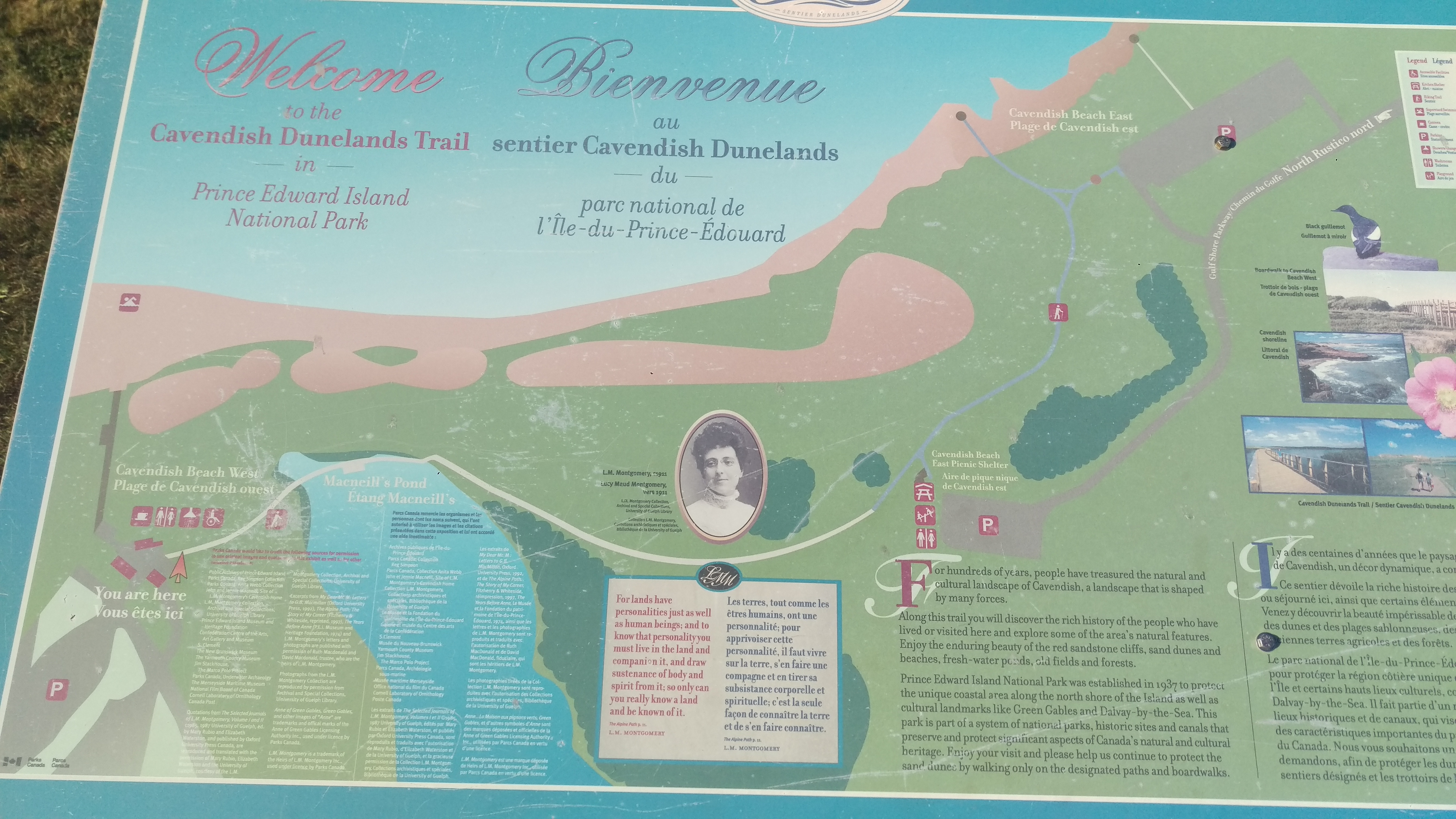
That’s how Canada feels to me.Tainted and bloody.I’ll get over it soon but before I do and before I forget I’ll recall the information panel I saw on Prince Edward’s Island.We spent a few days there on at the start of our few weeks here and on the second day walked down to the beach at Cavendish where we were staying in Anne of Green Gables Bungalows.There’s an area of dune and a lagoon near the beach and we walked the boardwalk along side the lagoon back towards the cottage.
The book Anne of Green Gables was written by L. M. Montgomery and naturally enough, given the location of the dunes and lagoon near the fictional location of the book, an area known and frequented by the author, the inspirational landscape of the book, information panels told us of the history of the landscape and it’s connection to the author.I was horrified.The panel reads:
“For hundreds of years, people have treasured the natural and cultural landscape of Cavendish, a landscape that is shaped by many forces.Along this trail you will discover the rich history of the people who have lived or visited here and explore some of the area’s natural features.”
As a starting point: Where are the people who were already here in this landscape?Montgomery’s tale sits on the lap of their destruction.Where are they?Why are they not the starting point?Later a panel goes into the natural history:
“The forests here were once very different.Thick, towering stands of yellow and white birch, red and sugar maple, beech, red oak, red spruce, eastern hemlock, eastern white pine and balsam grew right to the water’s edge.These species make up what is called an Acadian Forest.”
Where are the people? What species were they?What were they called?In an unintended politeness, an unwillingness to treat the indigenous, first nation, aboriginal as a species, like an animal, they are actually allowed to disappear from the record.A tree species list acts as a safe cipher for a people and culture.
It sickened me this panel and has coloured my image of this land as it now is.Tainted and bloody.
Of course it is rude to bring it up.Pointless for some.Offensive to others.Uncomfortable for some. Misplaced and over for others.Yet there is a process that is taking place, one of forgetting, of naturalizing what has happened, what happens.
It’s not that anything is to be done, I know.Not my place to do it either. Or to feel it. Yet I do.It’s here that my energies lie.My sympathies. I’m on holiday in a giant graveyard while the burials are still going on.