A note to posterity. I’ve been planning a journey up and down the A1 with Carl – taking photos and talking to people about service stations. I also want to follow the route of the A38 a road I see criss crossing the Sheffield to the SW route.
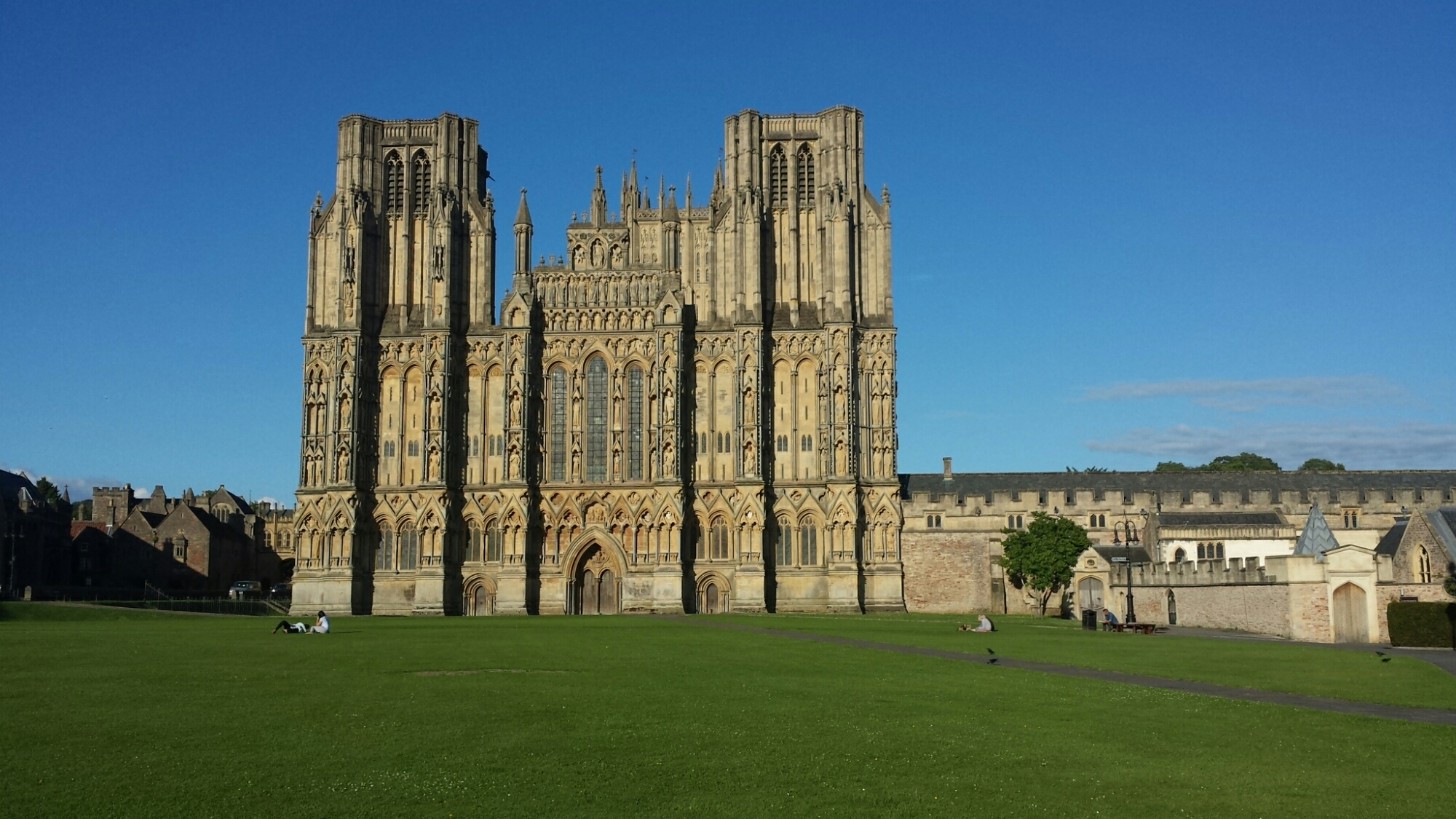
st martins chapel – wells
Yesterday eveving I attended Evensong at Wells Cathedral. I had gone assuming that it would be a sung Evensong but found myself in St Martins Chapel amongst a small group of worshippers with the Book of Common Prayer in my hands. I experience formalised worship like this as something akin to those little wisdom expressions that come in sweets, Chinese something cookies. I also have ideas of the I Ching in my mind, in the sense that I understand the texts of the Bible to carry the possibility of meaning appropriate to any circumstance. So I sat there listening or rather trying to keep up whilst listening as those taking part have a role to play in speaking through the responses and finding the correct rhythm to the pauses.
The meaning that I might have found is secondary to my surprise. I returned this morning to Matins to experience it again. The odd manufacture of the Christian liturgy, of the whole edifice is quite a construction. Most of all it is the maintenance of the Old Testament in the present. The constant reference to the people of Israel, the promise of God to the Israelites. In this century when the real Israelites have returned to the Holy Land (Holy through Jesus not David) the use of their name to speak of Gods purpose and mystery is very painful. No wonder that Islam sees Israel as the spear of a Christian west when the formal Church continues to rail at the Philistines.
Wash out your mouth said the Lord.
This land is not yours any more that theirs.
All fall short of my command.
Pharasees and Philistines alike.
It takes a mighty army or a sling
But either way its not justice recorded
But victory called by some defeat.
So its restful in St Martins Chapel, intimate, you might be next to a Bishop or pauper in a small room. Barely any one really cares is the truth. We pray for the Cathedral and it is a good measure of the faithful. Don’t trust God, War or food you gather from the floor. Don’t even trust museums, even living ones like this great edifice with its worshippers like lice eating a fictive dandruff. I’ve nothing against lice and they do live on and on.
Le Tour & weaving biographies
The Tour de France has just passed through Sheffield. There must be an enormous amount of writing concerning different ways that this race affects people and places. Over the two days the tour was in Yorkshire they estimate 2 ½ million people were out watching it. The tour is always followed by helicopters which give a birds eye view of the race as it winds across the hills and through the countryside. In my case the tour past less than 100 yards from my house. Earlier it had gone through the village of Bradfield where there is a Norman Motte of which I am very fond. On the third day the stage began on Parker’s piece in Cambridge and then, according to my father, later in the stage passed very close to Canning Town. These are all places that I have loved and in which I have spent time. My first impression of the tour was that it was a remarkable piece of landscape intervention, linking places via other places, populating a particular lying through with people, claiming routes as belonging to people. However after my father mentioned Canning Town I realised that the tour did something else. It offered a linking together of memory. A route which was sufficiently long to allow for people to weave their own biography.
letter to a dying friend
No need for reply dearest Richard – it is me that needs to write. I think about death quite a lot. Since being with my much adored mother through her death – life changed for me. Before reading your post I saw a woman I know a little this morning. Our eyes met and in her smile I saw a host of intimacies. Love and desire offer such possibilities which most of the time remain unspoken, unacted. People look at each other all the time and a myriad of silent thoughts animate each person, sometimes in parallel, sometimes horribly mistaken. Love and sex, the unbelievable urgency of birth and death. I wish you well in this affair you are conducting and – like those others who love you – respect your journey so far. I’m being selfish writing this to you – vicarious – but I will or our eyes won’t have met. xxx
Barking Scouts and Puritans
With my father and his partner we went to visit Conisbrough Castle. As is often the case I find Castle visits very anodyne and as on other occasions I was more interested in graffiti. There were the word:
BARKING S.A. SCOUTS

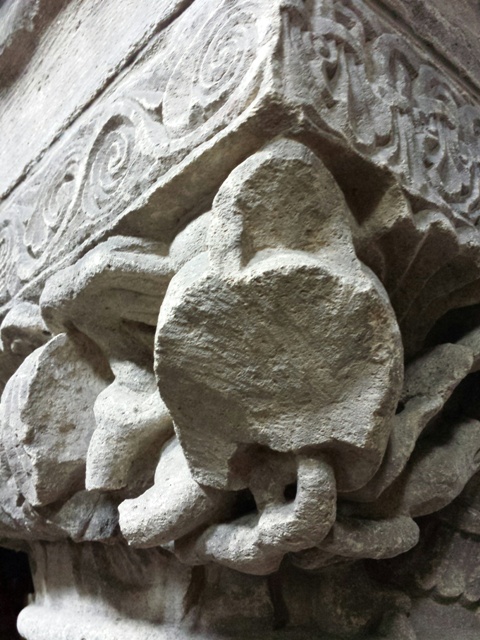
Carved into the stone on the ground floor of the sheet. My father comes from Stratford and for me this piece of graffiti was the most moving element of the trip. After visiting the castle we went to see the church of St Peters. Inside at one point my father pointed out that the heads of the figures on the capitals of the Norman pillars had been knocked off. This must have been done by the puritans. It made me reflect that whilst it is possible to remove the graffiti from city walls and from inside churches it is not really possible to remove the damage done to icons by the puritans. You can get rid of modern graffiti but she cannot get rid of the puritan challenge to authority whether you like it or not. It is a bit like whitewashing the desire to forget the difficult elements of history and to render them clean. To describe historical monuments, as to English Heritage, as if the past were nothing other than a comfortable children’s story. The Puritans left their mark in a way that cannot allow the violence of their challenge to be overcome.
JS
What strikes me about this case is that the 1960s and 1970s saw popular public broadcasting increasingly wishing to integrate broadcasters as contemporary entertainers themselves. Throughout the 1960s the driving forces of popular music (men) were people perceived as challenging public mores of sobriety and decency. The 1960s took forward a liberal agenda whether that be the swinging 60s, free love, the Rolling Stones or 1968. However the broadcasting authorities within the BBC were doubtless shy of employing anybody who might actually be challenging any of those mores. And to people who appeared to be doing so. Men older themselves than both the target audience and the entertainers capturing their attention were employed. People who carried enough of the symbolic accoutrements of this particular aspect of modernity were favoured over those who might embody them in a more unsettling and, in the imaginary of the broadcasting world, threatening way. Jimmy Saville is the case in point. They took someone who only looked as if he was a modern man but really, duplicitous, remained safe. However that duplicity was far deeper than one which simply served the purpose of broadcasting as we have discovered.
last rites
Patrick Duggan is dead. Pat. Queen’s Scout. Moustached. Flat cap. Always in order. Ready. I’ve been over contemplating death these past few days and I seem to have landed one big like a fish. He was found by his friend Norma on the bathroom floor and Saskia rushed over and pumped his heart until the medics arrived and they worked on him for half an hour but could not revive his life. Fit all the way through until the last two weeks when he had breathing problems stomach aches and today at 10 am he was due at the doctors to hear the results of the test. But one way or another he died naked on his bathroom floor. There is nothing sad about that. What I find strikes me more than his dead body are his dead objects. He was a man who never married and lived with his mother to her death and had around him household things, decorations, photos with such a long history to them. Victorian accoutrements that actually had memories which were his family memories. One or two of the stories I do know but as he had no living family besides his cousin there is nobody to inherit. It’s the end of the memory. Embodied in objects. Norma his partner was stoic despite finding him dead and I realised that she, like my father, remains stoic because the other choice is collapse. I was tearful talking to her and she asked me to stop which was fair enough. I think it is the thought of those objects finding their way to junk shops to antique shops which would we perhaps even worse.
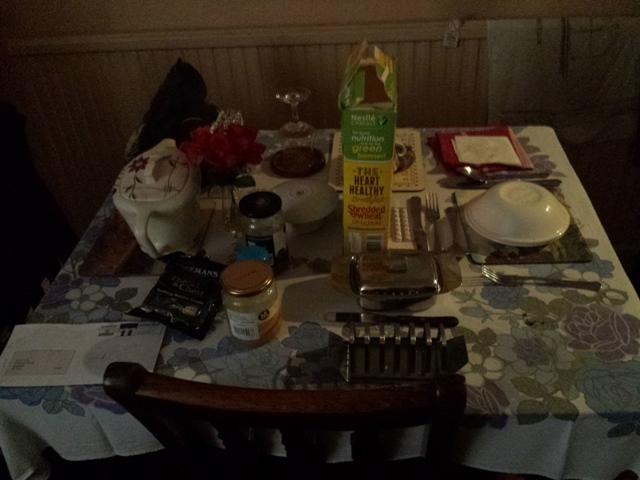
The photograph is the photograph of Pat’s table. Every meal was laid ready on the table after the previous meal. So he will have laid his breakfast table out the evening before he went upstairs. Underneath his sideboard has shoes with a shoe expander in them. His clock chimes the quarter hours. His jacket neatly hung behind the door.
pathos
How easy is melancholy to revive
Just now by it’s absence
I recalled finding the yellow archangel
On a lane in a wood in Berkshire when I was young
Which too is facile to evince
The sense of being old that comes with age and fatigue
I spend time on the edge of tears
I should maybe seep water to find relief
The ground is soft here
Returning to it might be a relief
Either death or simply pissing
Tall orders
We are overblown thinkers
Properly moved by logic
Those of us that think in this way
Using thought to regulate a sorry route
Following white lines catching cats eyes
Refueled along the way
A road just to get some where
Somehow oblivious to suffering
Despite everything that has happened
It is a soul less task living
Reason its measure
The butcher most of all
Nothing wasted
Even tall orders get fufilled
competitors, raptors and leeches…
So what I am about to write is best written when I am angry. Which I am not at the moment. But when I’m angry I don’t write things down.
I have had quite a long association with academia and received funding myself to pursue research. Now I am no longer so closely associated with academic work and to seize the universities in a very negative light. Much of the work I do is some sort of community work; elements of it are very similar to services provided within social services. I work with disadvantaged communities and the University, or rather academics within the University, hunt out groups like this in order to pursue research. At one level, often at a personal level of the academic’s commitment, this work is done by them in order to aid social mobility, bring issues to the attention of policymakers, impact on policy or simply raise consciousness of the issues faced.
This seems very straightforward but increasingly I perceive University academics as leeches, sucking blood from a body and putting back into it by extension simply a product to cauterise the wound or rather to keep the blood flowing without causing pain. Not causing pain is a reasonable ethical position but the aim of the leech is to extract blood and not to assist the body in question. University academics are by and large middle class intellectuals almost by definition. In order to validate much of the work they do they require disadvantaged people upon whom they exert their expertise. Poverty is very attractive. Difference is interesting. However what is it that they give back to those who are the subject of their research? It feels far more like they are preying on the poor and the different.
Another primary motor of academic research, perhaps the primary motive of academic research is entirely self serving. Like in all other areas of paid work people look for ways of being paid. Institutions search for rationales which justify their existence. The explanations which are given for researching those in poverty are heavy with a long history. Anthropology for example is well known for sharing origins with colonial practice. The anthropologist, possibly the academic in general, can appear to be a missionary. Their aim being to bring the word to those living in darkness. What is it that they are giving apart from the word? Rather like a colonial explorer who returns to the provincial town and populates the local museum with artefacts taken from a generous tribe, what does the academic do other than steal or at the very least borrow from another?
The power relations that exists between the universities and the population is it studies are powerfully uneven. The University represents the status quo, indeed quite simply the state. Whilst there is in the ether the heroic notion that one can succeed without a university degree, nevertheless, the absolute majority of people in positions of power have completed a university or equivalent education. Academic research always has to return something to academia itself which academia can judge of being of value. But how can the academia give value to the community that is studying unless it prioritises the needs of, perhaps the desires of, that community itself.
So I don’t express this very well because I don’t feel bitter and angry. I’m not naive and I know that my practice also expects a financial return for what I do. However something that universities don’t really take account of is the fact that people want them because of their money. They are seen as the holders of money yet they don’t even offer that in return for research because it might cloud the theoretical independence of the research. Research work should start with one question which is: what can we do which is of value to this group?
So as I work in community projects both voluntarily and with the aim of generating a partial income for myself, I perceive academia as a competitor, some sort of raptor circling the sky looking for a cluster of injured beasts.